
This series shines a spotlight on in-progress dissertations in the field of Catholic Studies and provides a space for Ph.D. candidates to promote their research. If you are interested in participating in this series please fill out this form. If you have any questions please contact Assistant Director, Allison Isidore at [email protected].
For our inaugural Emerging Scholars Forum, ACHA Assistant Director Allison Isidore spoke with Carlos Ruiz Martinez, a Ph.D. Candidate at the University of Iowa in the Religious Studies Department.
Carlos’s dissertation, titled “Sanctuary, Shelters, and the State: Religion and Immigration Enforcement in the United States,” focuses on the relationship between religion and immigration enforcement in the United States, from the 1980s sanctuary movement to the rise of a network of Catholic migrant shelters near the U.S.-Mexico border.
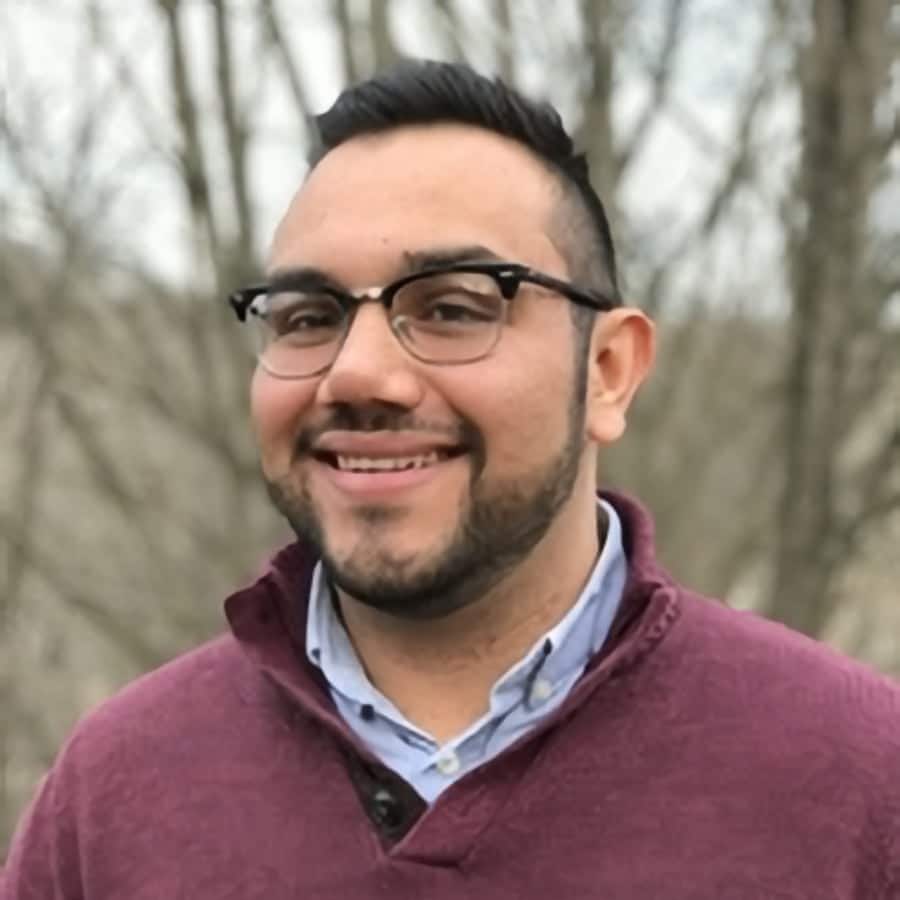
Allison Isidore (AI): Carlos, thanks for being here. I really appreciate you being our inaugural scholar.
Carlos Ruiz Martinez (CRM): Yeah, thank you for reaching out. I’m excited to talk about my research.
AI: So how did you get interested in this topic? You are investigating the sanctuary movement of the 1980s to now the networks of Catholic migrant shelters near the US-Mexico border.
CRM: There were two moments in particular that shaped this dissertation. The first moment was in 2021. Since 2018 I had conducted ethnographic research on the case of Alex Garcia , an immigrant from Honduras who had been ordered removed from the United States, and who instead sanctuary at a church in Maplewood, Missouri, which is a suburb of St Louis. The reason he took sanctuary is because federal immigration agencies, particularly ICE, had a policy that they would not enter a religious space to enforce immigration. It was a flimsy policy; there was no law preventing ICE agents from doing so. But historically federal immigration agencies have avoided entering religious space. The church offered him reprieve during the first Trump Administration, which made all undocumented immigrants a priority for removal, not just people with violent criminal records.
In 2021, shortly after the Biden Administration took office, Alex announced that he would be leaving sanctuary . He stood atop the steps to the church and said to the crowd, “Today, after three years, I am getting out of sanctuary.” And that language of getting out of sanctuary, alerted me that he had experienced sanctuary as a sort of form of confinement. He celebrated getting out of what many in the church had experienced as a beautiful and spiritually significant experience of tending to the needs of migrants. There was a sort of disconnect there.
The second moment right that really shaped what this dissertation became was when I was working at St. Francis Community Services , which is a part of Catholic Charities of St. Louis. A group of us was sent down to support La Frontera , which is a Catholic migrant shelter in Laredo, Texas that was receiving many immigrants daily, and had requested support from other Catholic organizations throughout the country.
Something that immediately struck me at the shelter was the fact that the migrants were coming in vans and buses that were sent there by ICE and Border Patrol. Migrants often came in with ankle monitors that ICE had placed on them before releasing them from detention. In turn, the shelter was then reimbursed by the federal government for these services rendered. There was an intimate relationship between the state strategies of immigration management and this Catholic migrant shelter that I wanted to explore. The shelter in Laredo is not unique. It was one of dozens of faith-based migrant shelters (mostly Catholic) that dot the U.S. side of the border from San Diego to Brownsville.
What I found is that these shelters were a key node the state’s strategy of surveilling immigrants. With immigration detention centers at capacity, ICE increasingly relied on releasing migrants under digital surveillance technologies like ankle monitors or placing them under case management supervision programs. They call these Alternatives to Detention . In 2014, the U.S. Border Patrol and ICE released thousands on migrants enrolled in ATD in bus stations in border cities, leading to a highly visible “crisis” that led to critique on both sides of the political aisle. Some were angry that migrants were being released without guidance or resources. Others were angry that migrants were being released from detention in the first place. Collaborating with migrant shelters allowed the government to continue to release migrants under ATD and digital surveillance technologies while pawning off humanitarian work to the Church, who had a commitment to serving immigrants.
AI: That is so fascinating. All I’m thinking about while you’re talking about this, is the relationship between the state and religious organizations. I think often especially I’m talking with my students and bringing up issues of religion and state cooperation, they often go, “But wait, separation of church and state, there’s supposed to be that wall.” I’m like, you study religion long enough you find out that that wall really is more like a fence that you can hop back and forth. And so, in talking about the role of religion in the state and especially within this kind of carceral dynamics, I mean a lot of US prisons when they first started becoming major forms of infrastructure had these religious overtones. I mean, we have solitary confinement, which part of that punishment was you’re supposed to read the Bible while you’re in there. And so, I’m wondering if you can talk more about this relationship between the state and religion, especially within Catholic nonprofits, and what that looks like in the 1980s compared to, say, 2026?
CRM: What has emerged in my dissertation is that the state engages religion quite strategically. In the 1970s and 1980s religious people in the borderlands noticed that there was an increasing number of undocumented migrants who were coming from El Salvador and Guatemala, two countries that were going through civil wars. If they were apprehended, these migrants would be deported to places where they may face death. These religious people organized to provide refuge and to call attention to this new migration. The “sanctuary movement,” as this ecumenical network of activists came to be known, sought to bring attention to the U.S.’ role in funding conflicts in Central America, as well as the U.S.’ systemic deportation of the very people that were displaced by such conflicts.
Anyway, the U.S. government criminalized such sanctuary work. They arrested and convicted people in the borderlands who were giving rides to undocumented Central Americans and even conducted an undercover investigation into the movement in southern Arizona. The Immigration and Naturalization Service went so far as to infiltrate churches as part of the investigation. This investigation led to a very public trial in 1985, which came to be known as the Arizona Sanctuary Trial. Five people, including a Catholic priest and a religious sister were convicted for crimes ranging from aiding and abetting illegal entry to harboring in Arizona. Of course, the judge understood the optics of convicting religious sisters, priests, and pastors for living out their faith. While they could have faced years in prison, the judge placed them on probation. Most notably, in his closing remarks he lauded those he convicted for their humanitarian concern but told them to work “within the system.”
By the 21 st century, you have the state strategically engaging religious organizations to care for the undocumented immigrants that they are detaining at the border and placing under digital surveillance technologies. They effectively gave religious people and institutions an avenue to live out their convictions “within the system” as the judge in the Arizona sanctuary trial had recommended.
AI: I want to stick with this idea of sanctuaries more as you were talking about what influenced you into starting this project you’re talking about Alex Garcia who took sanctuary in the actual church, it would be a miss not to now address how in this second Trump administration, they have rescinded the original policy , now stated that ICE can now go into sanctuaries and go into religious buildings and obtain undocumented individuals. Could you talk more about that switch from 2016 to 2026 and how in 10 years there has been a dramatic change.
CRM: Things radically changed when Trump came into office for his second term. One of the first things that this administration did was to rescind the sensitive locations memo that prevented ICE agents from ordinarily entering religious spaces. This decision had complicated effects. On the one hand, federal immigration agencies continue to understand that religious spaces, for Americans, are “special” to invoke Ann Tave’s work on how we collectively sacralize certain places, things, or ideas. So it did not mean that agents were entering churches left and right. But the decision was still a power move right to say “We can enter if we want to” This has a disciplining effect.
The effects of this decision were also felt unevenly. For example, in the summer of 2025 Alberto Rojas, the Bishop of San Bernardino, a majority Latino diocese, offered a dispensation to Catholics in his diocese from the Holy Catholic obligation of attending Mass if they had a legitimate fear of ICE enforcement. At least to my knowledge, the first time that there’s been a dispensation given for issues related to immigration enforcement. It’s a pretty clear example of how these governmental decision shape the religious life of Catholics in the United States.
There was another incident recently in January in which a man, Wilson Rogelio Velasquez Cruz was attending service at Iglesia Fuente de Vida (Fountain of Life Church) in Georgia. He had an ankle monitor on, placed by ICE. ICE triggered the device, so that it started beeping and causing a disturbance. When he stepped outside to deal with his beeping ankle monitor, he was detained by ICE. ICE agents did not actually go into the church, but they were able to use digital technologies to coax him out of the church. They profaned this religious space, if you will, without actually having to go in.
The Trump Administration was also quite critical of the network of Catholic migrant shelters, arguing that these shelters encouraged people to enter illegally. Within a few weeks, funding for these shelters was cut off. The last time that I was at La Frontera, the shelter in Laredo, Texas, was in April of 2025 and it was quite empty. During previous visits, the shelter may have seen hundreds of people per day, but in April they were receiving 4-5 people daily. Notably, these shelter guests were not being detained near the border. They had been detained as part of ICE operatives throughout the country, in places as far from Laredo as Florida and New York, shuffled through detention centers, and then released on bond. They were turned over to the Catholic shelter to help them coordinate their travel back to the same city where they were detained. The fact that ICE was turning people over to the shelter who they had detained in places like New York, and not at the border, really highlights the strategic benefit of these shelters for the state: they are places where they can release people and the shelter will step in to help coordinate the transportation.
AI: I am having a hard time wrapping my mind around the government’s logic. To detain someone in, say, New York, and then transferring them down to a detention center in Texas or Louisiana, and then releasing them to a shelter in a Bordertown and saying, “now go back to where you got originally arrested.”
CRM: Absolutely. It’s part of a cruel shuffling game shaped by the government’s interest in isolating migrants, keeping detention space open for more migrants to come into the system, and surveilling migrants who are released. Historian Brianna Nofil demonstrates that the federal government has relied on jails in rural communities for immigration detention space. These contracts bring money to rural communities, but also isolate migrants from their family and legal services. With more and more people being detained under this administration, detention space fills to migrants are constantly transferred. Most are deported. But those who are released on bond may be released in Texas instead of New York simply because they were shuffled around so much to keep detention space open.
AI: This leads me to my next question. What is your research method for this dissertation? It sounds like there is a large ethnographic portion.
CRM: My dissertation, Sanctuary, Shelters, and the State: Religion and Immigration Enforcement in the United States , combines historical and ethnographic research methods. I conducted archival research with the Sanctuary Trial Papers at the University of Arizona in Tucson. This research was key for the first part of my dissertation, which focuses on the sanctuary movement from the 1980s through the first Trump Administration.
The second part of my dissertation focuses on Catholic migrant shelters and accompaniment programs. I conducted most of my ethnographic research in Laredo, Texas, although I traveled to other shelters in Eagle Pass, Texas and McAllen. I also spent a limited amount of time in shelters on the Mexican side of the border. One of the trickiest parts of conducting this research is balancing relationships and remaining true to my analysis. Through my work I bring forth a critique of how faith-based migrant shelters are embedded in state strategies of immigration control. But at the same time the staff and volunteers welcomed me with open arms and gave me pretty open access. I turned to the work of anthropologist Didier Fassin, who does critical work on humanitarian organizations, which as he notes often evade critique.
AI: What do you want for readers to take away from your dissertation and hopefully future monograph?
CRM: I’ll answer it in two parts. First, if I’m thinking about my scholarly intervention, I want scholars to kind of grapple with how religion can be intertwined with state strategies of immigration control. In the broad literature on religion and migration, religious people and institutions often show up as doing the work of protesting unjust and inhumane immigration policies. There is certainly a long tradition of religious solidarity with immigrants, but it is also important to be critical of the ways in which religion is also embedded in carceral systems of immigration control, surveillance management these carceral systems. Faith-based migrant shelters are a good example.
Second, I want my work to offer those who work with immigrants beyond the academy a tool to understand some of the ways that immigration justice work can ironically replicate state strategies of immigration control. Shelters like La Frontera were quite popular destinations for Catholics across the country to do solidarity work. Parishes, high schools, and even universities like Marquette, Creighton, and Notre Dame sent groups of students to volunteer at shelters like La Frontera. On the one hand, they may have helped to provide a warm meal to a family, given a moment of joy to a family while they played with their child at the shelter. On the other hand the shelters were key for governmental efforts to place hundreds of thousands of people under digital surveillance mechanisms.